
Financial Literacy and Record Keeping with the Matuber Women's Organization in Maguindanao del Norte
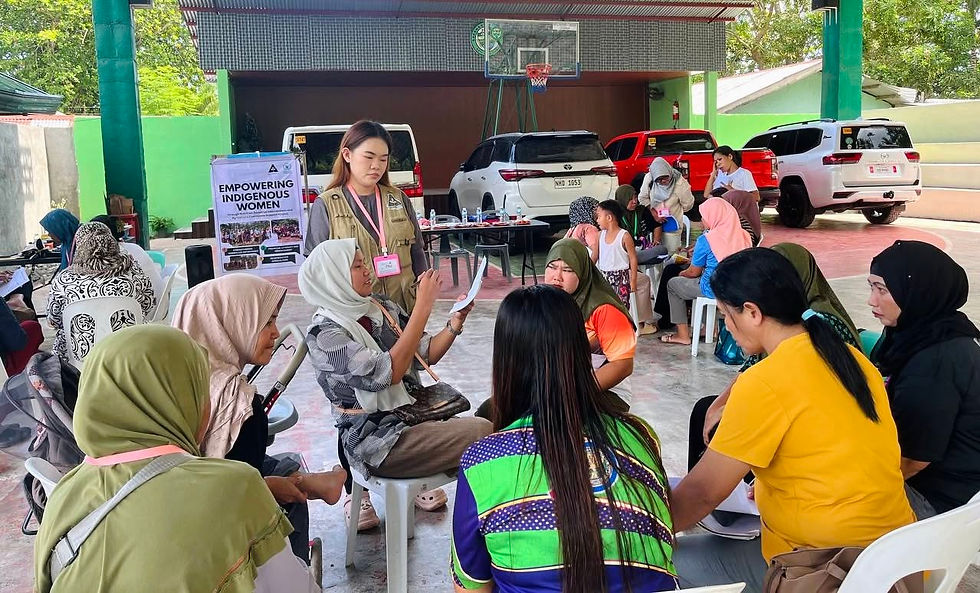
The Matuber Women's Organization strengthened its financial management and record-keeping skills in a session under the AGREA–WFP collaboration in Maguindanao del Norte.

The ledger as a tool for accountability
A women's organization that cannot show its members where the money went will struggle to keep their trust. A livelihood enterprise that cannot calculate its costs will struggle to know whether it is actually earning.
The Matuber Women's Organization in Datu Blah T. Sinsuat, Maguindanao del Norte, spent a session working on both problems. The training focused on proper financial management, transparency, and accountability, practical skills for managing livelihoods and organizational funds.
One member captured the core of the session in a single sentence:
“Mahalaga ang pagre-record ng mga gastos at kinikita.”
Translated: “Recording expenses and income is important.”
The statement is simple, and it names the foundation of every other financial practice. Budgeting depends on knowing what you spend. Savings depend on knowing what you have left. Transparency depends on having a record that members can examine. Without the ledger, the rest is guesswork.
Why this session matters for a women's organization in BARMM
Matuber is a barangay in Datu Blah T. Sinsuat, a municipality in Maguindanao del Norte with twelve barangays and a population spread across coastal and upland areas. The municipality is part of the Bangsamoro Autonomous Region in Muslim Mindanao (BARMM), where poverty incidence and food insecurity remain among the highest in the country.
Women's organizations in the region often manage multiple streams of resources at once: member contributions, earnings from collective enterprises, and support from government or development programs. Each stream comes with expectations, of reporting, of accountability, of responsible use. An organization that cannot track these flows risks losing access to future support, or worse, losing the confidence of its own members.
The session’s focus on transparency and accountability is therefore not an abstraction. It is a condition for the organization’s credibility, both internally and with the institutions it partners with.
The session's content
The training covered the mechanics of financial management: tracking expenses and income, maintaining records that members can understand, and using those records to make decisions.
For a women's organization, the practical application is immediate. A collective enterprise, whether it involves food processing, farming, or small-scale trading, generates costs that are easy to overlook: transport, packaging, spoilage, the unpaid time of members. A record that captures only cash sales and not these costs will overstate profit and understate the true cost of the activity.
The session also addressed organizational funds, which carry a different kind of responsibility. Money contributed by members or entrusted by a partner is not the organization's own revenue. It must be accounted for separately, reported on clearly, and used for the purposes agreed. Transparency in this context means that any member can ask to see the books and receive a straight answer.

The WFP–AGREA collaboration and the AECID project
The Matuber session is part of the continuing collaboration between AGREA Foundation and the United Nations World Food Programme (WFP).
That collaboration sits within a broader project: Empowering Indigenous Women through Nutrition-sensitive Interventions and Agriculture Livelihoods Support towards Improved Food and Nutrition Security and Climate Resilience. The project is funded by the Spanish Agency for International Development Cooperation (AECID) with a contribution of PHP 45 million (approximately USD 780,000) and is implemented by WFP. It aims to reach 28,000 people from Indigenous and rural communities across BARMM.
WFP states that under the project, rural and Indigenous women will undergo training in climate-resilient agriculture and leadership skills. The project also aims to strengthen women's cooperatives by linking their agricultural production to reliable markets, and it incorporates social and behavior change activities to improve local food and nutrition practices.
The rationale is documented. A 2024 WFP study, Leaving No One Behind, found that barriers such as climate-related risks hinder rural and Indigenous women from accessing resources and decision-making processes, resulting in lost livelihood opportunities and poverty. Financial literacy training addresses one dimension of that exclusion: the practical capacity to manage, track, and control the resources a household or organization already has, and to account for them credibly.
The Bangsamoro Government's Cooperatives and Social Enterprise Authority has described related work with eight women-led farmer cooperatives from Maguindanao del Norte and Maguindanao del Sur, which joined organizational development sessions to strengthen their role in local food security. That initiative involved the Bangsamoro Women Commission, the Ministry of Agriculture, Fisheries, and Agrarian Reform, and WFP, with AECID support. The Matuber session reflects the same approach at the community level.
What the session does not yet prove
A training session on record keeping is an input. It is not evidence that the Matuber Women's Organization now maintains complete books, that its members have adopted consistent recording practices, or that its financial position has improved.
Those outcomes depend on whether participants have the materials and time to keep records, whether the organization's leadership reinforces the practice, and whether the broader project provides follow-up support rather than a single visit.
The project's market-linkage component creates a practical test. As the organization engages more directly with buyers and with government programs, its records will either become an asset—evidence of performance that strengthens its position, or a gap that limits what it can access. The training introduced the skill. The market will test whether it is used.
What comes next
For the members who attended, the immediate next step is to apply the practice at the smallest useful scale: a simple record of what comes in and what goes out, kept consistently, reviewed periodically.
For the organization, the next step is to decide whether record keeping becomes a shared institutional practice, with a designated bookkeeper, a standard format, and regular reporting to members, rather than an individual habit.
For AGREA Foundation and WFP, the next step is to continue the module series and to track whether the financial practices introduced are adopted and sustained. That tracking should be honest about what changes and what does not.
A note of appreciation
To the members of the Matuber Women's Organization who participated: the discipline of writing down what you spend and what you earn is unglamorous, and it is the foundation of every other financial decision. The willingness to be accountable to one another is the beginning of institutional trust.
To learn more about AGREA Foundation's work with women's organizations in BARMM and its partnership with the World Food Programme, explore our official channels. Organizations interested in supporting this work can reach out through our contact page.


