
From Being Taught to Measuring by Hand: Session 2 in Regenerative Agriculture with the STFI Women
AGREA Foundation and WFP held Session 2 with the STFI women in BARMM, covering field layout, four-category crop rotation, raised beds, and organic concoctions.

The tape changes hands
The measure of a training is not what happens while the trainer is holding the tape. It is what happens after.
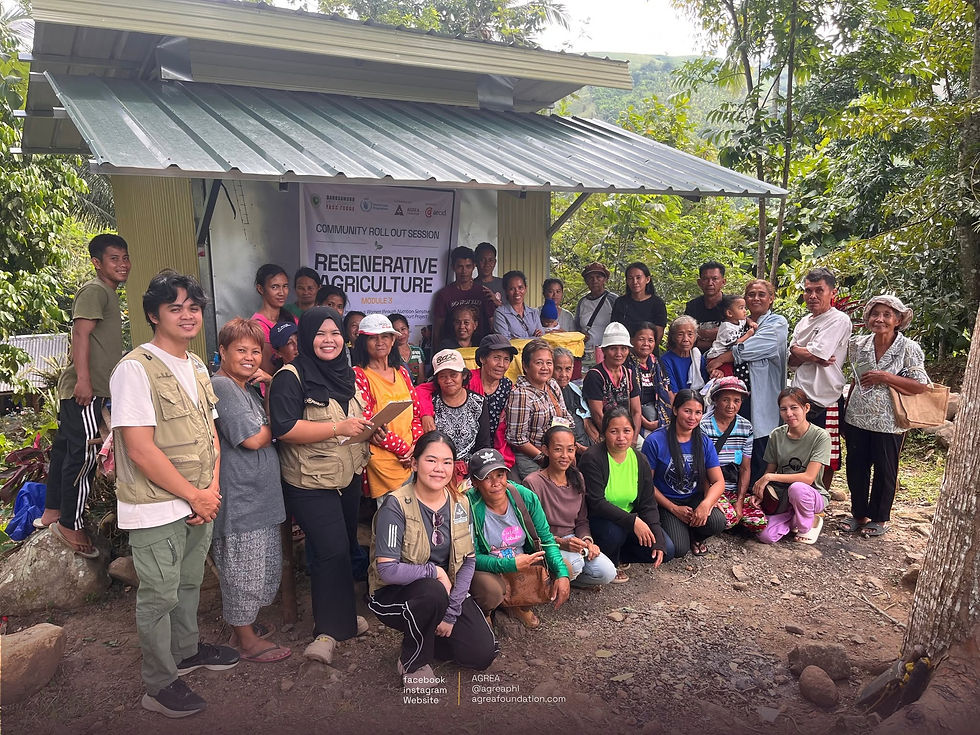
AGREA Foundation conducted Session 2 on Regenerative Agriculture with the Senorodoroy de Teduray Dob Fusakae Inged Women's Association (STFI) in the Bangsamoro Autonomous Region in Muslim Mindanao. The session covered field layout, land preparation, crop rotation, and natural farm inputs.
What distinguishes Session 2 from the session that preceded it is not new content delivered but new hands on the work. According to AGREA's account, after being taught how to measure and divide a farm area, the participants immediately measured their own field by hand, divided it into four sections, and planned where each crop category would go. The women and their husbands built raised beds and pathways. They mixed three organic preparations from materials available locally.
An earlier session with the same association covered seed saving and seedling propagation. This one moved from the seed to the field that would receive it.
Dividing a field into four: what the exercise teaches
The four sections were assigned to legumes, root crops, leafy vegetables, and fruit-bearing crops. That division is not an arbitrary way of organising a demonstration plot. It is the physical form of crop rotation, and it carries specific agronomic logic.
A Benguet State University technoguide on farm planning and organic agriculture management sets out the practice directly: plant four categories of vegetables in a bed — leafy, root, legume, and fruit — and rotate each category to a different subdivision of the bed every season. The same guide distinguishes crops by their fertiliser demand, identifying legumes as "giver crops," cabbage as a "user crop," and corn as a "heavy user crop".
That distinction is the reason the rotation works. Legumes fix nitrogen through their root nodules, leaving the soil richer than they found it. Leafy vegetables are heavy nitrogen users that draw on what the legumes left behind. Root crops feed at different soil depths and tolerate poorer conditions. Fruit-bearing crops are heavier feeders with longer seasons and are often the group most vulnerable to soil-borne disease when planted in the same spot repeatedly.
The rotation is a framework rather than a fixed rule. Published accounts of Philippine vegetable farms note that rotation patterns vary according to soil conditions, market demand, and labour availability, and that growers are generally aware of the benefits for soil fertility and pest and disease control even when they do not follow a rigid sequence. The session's group activity — assigning each group a crop category at random — appears designed to make that flexibility concrete: each group had to reason about what its category needed, what it would leave behind, and where it should go next.
Spacing is not a preference
The second element was crop spacing, and the lesson was that the correct distance depends on the crop.
Published spacing tables bear this out. Cabbage is commonly planted at 30 centimetres by 30 centimetres in double rows. Spinach is planted far more densely, at 11 centimetres by 11 centimetres. Tomato and eggplant are given substantially more room, with recommendations running to 100 centimetres by 50 centimetres in some references and 60 by 80 centimetres in older Bureau of Plant Industry guidance.
The differences reflect the size of the mature plant, its root spread, and how much light and airflow it needs. Spacing determines humidity in the canopy and therefore disease pressure. It determines whether a farmer can walk through the plot to weed, water, and harvest without damaging the crop. And it determines how many plants a given area can support, which is ultimately a question about yield.
A field laid out without measurement tends to waste space on paths wider than necessary and to crowd crops that need room. Measuring and dividing is an attempt to replace that improvisation with a plan — and, importantly, a plan that can be repeated next season.

Raised beds and where the water goes
The third element was land preparation: building raised beds with pathways between them.
The design principle is documented in vegetable production manuals. Low raised beds are constructed with footpaths between each bed to provide access to the crop plants and adequate drainage, with typical dimensions of about one metre wide and ten centimetres high. On sloping ground, beds are usually aligned along the contours.
The drainage function is not incidental. The same manual records that the raised bed and footpath layout provided adequate drainage during heavy rainstorms, with excess water running off along the footpaths between the beds and into drainage channels or farm sumps. A bed that drains is a bed where a crop does not rot after heavy rain. A path that channels water is a path that does not become a trench.
The width matters for a second reason. A bed about one metre across can be reached from both sides without stepping on it, which prevents the soil compaction that comes from walking on beds. That is a small design decision with a long-term effect on soil structure.
Three concoctions, three jobs
The fourth element was the preparation of three natural farm inputs: Fermented Plant Juice (FPJ), Fermented Fruit Juice (FFJ), and Oriental Herbal Nutrient (OHN).
These are established preparations within the Department of Agriculture's Natural Farming Technology System, which documents OHN alongside Indigenous Micro-Organisms, FPJ, FFJ, fish amino acid, and calcium phosphate as components of the system. A JICA-supported production guide for vegetable growers describes concoctions generally as liquid fertiliser, pest repellent, and growth promoter applied directly to plants or to the soil.
The Department of Agriculture's OHN formulation is specific: ginger, garlic, molasses, and coconut vinegar for the first fermentation, with chili and makabuhay added in a second and third extraction. The documented benefits are pest, worm, and fungus control, support for animal skin health, and contribution to soil and plant condition. The recommended application is two tablespoons per litre of water, sprayed on leaves or poured at the base of the plant, in the early morning or late afternoon.
The economic logic is what makes these preparations relevant to a women's association. A farmer who buys synthetic fertiliser and pesticide every season must find the cash before the harvest arrives. A farmer who can produce inputs from materials already at hand — vegetable trimmings, overripe fruit, ginger, garlic, chili — has reduced that cash requirement. She has also reduced her exposure to price movements in external inputs, which in BARMM in early 2026 meant diesel rising by as much as ₱11.88 per litre and gasoline by ₱6.47 per litre in March alone.
According to AGREA's account, the women and their husbands prepared all three and are now planning to bring the practices back to their farms, producing inputs from resources within their communities rather than depending solely on purchased synthetic inputs. That is an intention, not yet a result. It is the kind of intention that a season will test.
Why this matters in Datu Blah T. Sinsuat
The session's emphasis on field planning and locally produced inputs is not happening in a neutral season or an easy place.
Datu Blah T. Sinsuat is a coastal municipality in Maguindanao del Norte with a substantial Teduray population. Reporting in 2024 documented what a prolonged dry spell did there: in Barangay Nalkan, water sources dried up and children trekked hilly, landslide-prone ground to draw water from springs; in Barangay Tambak, a mostly Teduray community, drought made it difficult to sustain farming, and roughly 40 hectares planted to coconut, corn, ube, and peanut were damaged.
That is the baseline against which a session on raised beds and homemade inputs should be read. These practices do not make a farm immune to drought. They do reduce the number of ways a season can go wrong — by spreading risk across four crop groups instead of one, by keeping soil covered and structured so it holds moisture, and by lowering the cash outlay required before a harvest arrives.
The partnership and the climate it operates in
The session is part of the continuing collaboration between AGREA Foundation and the World Food Programme, under a project funded by the Spanish Agency for International Development Cooperation.
WFP describes the project as a PHP 45 million (US$780,000) contribution from AECID to enhance agriculture-related livelihoods and boost the climate resilience of indigenous women in BARMM, reaching 28,000 people from indigenous and rural communities. Under it, rural and indigenous women undergo training in climate-resilient agriculture and leadership skills, women's cooperatives are strengthened by linking production to reliable markets, and activities incorporate social and behaviour change to improve local food and nutrition practices.
The rationale is stated plainly in WFP's announcement. Violeta Dominguez Acosta, Head of Spanish Cooperation in the Philippines, said: "If we are talking about climate resilience in a country most at risk of extreme climate, we must put indigenous women and their communities at the centre of the action". WFP Philippines Representative and Country Director Regis Chapman added: "With the increasing frequency and intensity of climate emergencies in the Philippines, women are especially vulnerable. It is urgent that we strengthen their capacities and so that they can withstand shocks better".
The project's diagnosis rests on WFP's 2024 Leaving No One Behind study, which found that barriers such as climate-related risks hinder rural and indigenous women from accessing resources and decision-making processes, resulting in the loss of livelihood opportunities and poverty.
The regional conditions are severe. On May 14, 2026, Chief Minister Abdulraof Macacua placed the entire BARMM under a state of calamity under Proclamation No. 0002, Series of 2026, citing the combined impact of the global oil crisis and the El Niño phenomenon, with climate models projecting the phenomenon to continue until early 2027. According to MAFAR Minister Abunawas Maslamama, around 800 rice and corn farmers in Maguindanao del Sur and Maguindanao del Norte had been affected; as of April 24, about 851 hectares across 36 municipalities and 167 barangays were damaged — 537 hectares of rice and 314 hectares of corn — with losses of roughly 1,500 metric tons.
What the session does and does not establish
A learning session is an input. It is not evidence that the women have reorganised their fields, that they will maintain a four-part rotation, that the concoctions will be prepared correctly and applied at the right concentration, that yields will increase, or that their farms will withstand the next dry spell.
Those outcomes depend on follow-through: whether the layouts fit the land and water available, whether the rotation can be sustained when a household needs a particular crop at a particular time, whether the concoction materials remain accessible through the year, and whether the association reinforces the practices in the months after the session.
The honest measure is not the enthusiasm in the room. It is what appears in the following season: a plot staked into four sections, beds that drain after heavy rain, jars of fermenting preparation labelled with dates on a shelf, and a field managed according to a plan rather than improvised.
What comes next
For the participants, the next steps are concrete: stake one plot into four sections before the next planting; record which crop group went where so the rotation can be repeated and adjusted; prepare one concoction, label it with the date, and observe the result on a small area before applying it widely; and check after the first heavy rain whether the pathways are carrying water away from the beds rather than into them.
For the association, the next step is to decide whether these practices become shared activities — a communal demonstration plot, a shared production area for concoctions, a schedule for preparing inputs together — rather than individual habits.
For AGREA Foundation and WFP, the next step is to continue the collaboration and track whether the sessions contribute to changes in practice. That tracking should be honest about what changes and what does not.
A note of appreciation
To the women of STFI and their husbands who measured the field by hand, divided it into four, built the beds, and mixed the preparations: the least glamorous parts of farming are the parts that determine what the next season looks like. Doing them together is how they become a practice rather than a one-time exercise.
To learn more about AGREA Foundation's work with women farmers in BARMM and its partnership with the World Food Programme, explore our official channels. Organisations interested in supporting regenerative agriculture and nutrition programming can reach out through our contact page.


