
Gender and Care in Agricultural Value Chains: Inside AGREA’s Session with Farmers and Partners in Marinduque
AGREA Foundation convened farmers, women food producers, and Farm School trainees in Marinduque for a session on gender, unpaid care work, and inclusive agricultural value chains.

The work that does not appear in the ledger
A value chain map usually shows production, processing, transport, marketing, and consumption. It rarely shows who cooked the meals that made the production possible, who stayed home with a sick child while the harvest was brought in, or who woke before dawn to fetch water and feed livestock before attending a cooperative meeting.
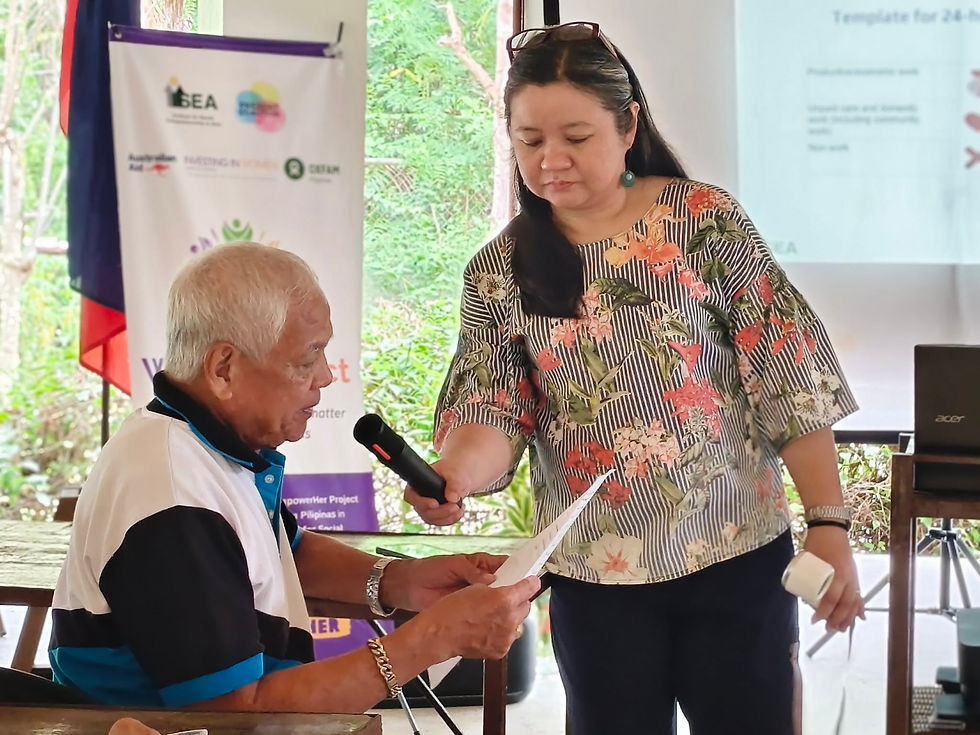
On July 24, AGREA Foundation convened a Gender and Care Session with Value Chain Partners in Marinduque to put that invisible work on the table. Participants came from the Regenerative Farmers Association in Malibago (RFAM), the Women Food Producers Association (WFPA) Marinduque, and the Wave 22 Organic Agriculture Production NC II trainees of AGREA Farm School.
The session was not designed to add a gender component to an agricultural program. It was designed to examine a structural feature of agricultural value chains that is often treated as background: the unequal distribution of unpaid care and domestic work, and the way that distribution shapes who can participate in production, processing, and markets—and on what terms.
What “gender and care” means in a value chain
Care work is the labor of maintaining households and communities: cooking, cleaning, fetching water and fuel, caring for children, older people, and sick family members. It is work. It is necessary. And in the Philippines, it is overwhelmingly performed by women.
The Philippine Commission on Women reports that when women spend nearly 11 hours a day on unpaid care and domestic work, they have less time and opportunity to participate equally in other spheres of life. A presentation at an ISEA webinar in August 2025 put the figure at an average of 6.5 hours a day for women—nearly three times the time spent by men—while noting that this work is undervalued yet essential for households, communities, and the economy.
That time constraint has direct consequences for agricultural value chains. A woman who spends her morning on care responsibilities arrives at the farm later, or not at all. She may send a family member in her place, which affects the quality and consistency of the work. She may decline a training session scheduled at an inconvenient hour, or a buyer meeting that conflicts with a school pickup. Over a season, those small constraints compound into measurable differences in productivity, income, and voice.
ISEA’s research on women in agricultural value chains describes the pattern precisely. Women contribute across farming, marketing, household work, and community work—much of it unpaid or underpaid. Agricultural work often becomes an extension of domestic responsibilities. Women face physical strain from manual labor, limited access to agricultural services, and time poverty driven by care work. They also have limited ownership of land and assets, even as they manage household finances and access credit. And despite active participation in organizations, barriers such as distance, cost, and domestic responsibilities limit their full engagement.
This is not a marginal issue. As of March 2023, approximately 2.7 million women farmers, fisherfolk, and agricultural laborers were registered in the Registry System for Basic Sectors in Agriculture—about 43 percent of all registrants. Yet women accounted for only about 27.5 percent of employed persons in agriculture, forestry, and fishing in 2024, according to the Philippine Statistics Authority. The gap between presence and recognition is the space that a gender and care lens is designed to examine.
The framework behind the session
The session drew on a framework that ISEA has developed over years of research and practice: the Benchmarks for Transformational Partnerships and Women’s Economic Empowerment in Agricultural Value Chains (BTP-WEE in AVCs).
The Benchmarks were developed through an ISEA–Oxfam–SIDA project on gender-transformative agricultural investments in Southeast Asia, drawing on eight case studies of social enterprises and inclusive businesses working with women small-scale producers in Indonesia, the Philippines, Thailand, and Vietnam. They are designed as an assessment and planning tool—a scorecard that social enterprises, MSMEs, and corporate agribusinesses can use to evaluate their adherence to transformational practices.
Those practices include enabling workplace policies and culture, women’s participation and leadership, access to resources, partnerships, community-based innovations, and accountability in advancing women’s economic empowerment in agriculture.
Ms. Leilani Briosos-Mc Donough of ISEA, one of the session’s resource persons, has presented this framework extensively. In a prior webinar, she explored the intersection of gender and agriculture using the Benchmarks, examining women’s multiple roles in value chains and the barriers—physical strain, limited access to services, time poverty, constrained asset ownership—that limit their participation.
Ms. Catherine Tiongson, also of ISEA, coordinates the EmpowerHer Project, which supports social enterprises in initiating, documenting, adopting, and championing gender- and care-responsive practices. EmpowerHer is co-implemented by ISEA, the PRESENT Coalition, and Oxfam Pilipinas, with support from the Australian Government’s Investing in Women initiative.
Ms. Katrina Guanio of Oxfam joined the Marinduque session. Oxfam Pilipinas has been working on unpaid care and domestic work in the Philippines since at least 2013, when the country was one of the first to pilot qualitative and quantitative methodologies on the topic. Its recent EmpowerHer baseline study, conducted from December 2025 to February 2026 with 20 key informants from social enterprises and value chain partners, examined existing formal and informal practices and policies supporting gender equality and unpaid care and domestic work. The study surfaced critical gaps between belief in and practice of equitable sharing of unpaid care work at home—a finding that is as relevant to farming households as it is to enterprise workplaces.
Why these partners, in this place
Marinduque is where AGREA began in 2014, on a small patch of land, with the goal of building a replicable one-island economy. It is also where the organization’s community mechanisms are most developed.
The Women Food Producers Association (WFPA) Marinduque is AGREA’s tangible community mechanism under its FORWARD program, established so that women Farm School graduates can engage with AGREA as partners in development. The WFPA is part of a network that has grown to over 1,000 members across multiple chapters, formed in 2020 under the Department of Labor and Employment.
The Regenerative Farmers Association in Malibago (RFAM) represents partner-farmers working on regenerative agriculture in the municipality of Torrijos. AGREA has documented RFAM members participating alongside WFPA members and Farm School graduates in its partner gatherings, indicating an established working relationship rather than a one-off invitation.
The Wave 22 OAP NC II trainees are the most recent cohort at AGREA Farm School, completing the 32-day Organic Agriculture Production NC II training under the Coconut Farmers Scholarship Program. Their inclusion in a gender and care session is deliberate: they are entering agricultural livelihoods, and the norms they encounter now—about who does care work, who speaks in meetings, who controls income—will shape what they are able to build.
Bringing these three groups together is not incidental. A value chain is only as inclusive as the relationships among the actors in it. If the farmers who produce, the women who process and market, and the new entrants who will soon join them do not share an understanding of how care responsibilities distribute opportunity, the chain will reproduce the same exclusions it has always had.
What the session did and did not do
The session was structured around learning, sharing experiences, and conversation. It examined gender equality, women’s economic empowerment, and the recognition of unpaid care work in homes, farms, and communities.
What it did not do—and could not do in a single day—is produce measurable changes in the division of household labor, in women’s decision-making authority, or in the structure of Marinduque’s agricultural value chains. Those outcomes depend on sustained practice, on organizational policies that accommodate care responsibilities, and on follow-up support.
The session’s stated premise is that strong value chains are built not only through better farming practices but by creating opportunities where women and men can contribute equally. That premise is a direction, not a result. Whether it translates into changed arrangements—a meeting scheduled at a time that allows caregivers to attend, a cooperative policy that recognizes care responsibilities, a household that renegotiates who fetches water—will depend on what participants do with the conversation.

The wider frame
The session sits within a broader body of work on gender-responsive enterprise in the Philippines. The EmpowerHer Project, implemented by ISEA, the PRESENT Coalition, and Oxfam Pilipinas with Investing in Women, supports social enterprises in adopting and documenting gender- and care-responsive practices. Its WEE Connect Community of Practice brings together enterprises and value chain partners to learn from one another, and its webinars have examined why gender matters in value chains and how enterprises can apply Philippine gender and WEE laws in workplaces and supply chains.
AGREA’s own trajectory reflects a similar emphasis. Its Farm School was designed with gender-sensitive training modules after it found that fewer than 20 percent of its first cohort of scholars were women. The modules integrate dream-building, leadership, values formation, and financial literacy at the start of training, before technical agricultural content—an acknowledgment that technical skills alone do not shift who participates or who leads.
The Marinduque session extends that logic from the classroom to the value chain. It treats care work not as a private matter that sits outside agricultural programming, but as a factor that shapes every link in the chain—from who can attend a training to who can negotiate a price to who can take on a leadership role in a cooperative.
What comes next
For the participants, the next step is to carry the conversation into their own organizations: to examine whether meeting times accommodate care responsibilities, whether leadership roles are structured in ways that exclude caregivers, and whether the division of labor at home is treated as a personal arrangement or a shared one.
For AGREA, ISEA, and Oxfam, the next step is to continue the collaboration and to track whether the session contributes to changes in practice—not simply in awareness. That tracking should be honest about what shifts and what does not.
We are grateful to Ms. Leilani Briosos-Mc Donough and Ms. Catherine Tiongson of ISEA, and to Ms. Katrina Guanio of Oxfam, for sharing their time and expertise. And to the farmers, producers, and trainees of Marinduque who participated: the work of recognizing care is slow, and it begins with naming it.
To learn more about AGREA Foundation’s work with women food producers and its FORWARD program in Marinduque, explore our official channels. Organizations interested in gender-responsive value chain partnerships can reach out through our contact page.


