
When Husbands and Ustads Join the Session: Regenerative Agriculture with the SSB Ummahat and Muminats Agriculture Cooperative
AGREA Foundation and WFP convened the SSB Ummahat and Muminats Agriculture Cooperative in BARMM for a regenerative agriculture session attended by women, their farmer husbands, and Ustads.

Who was in the room
Most agricultural trainings are designed for one kind of participant. This one was not.
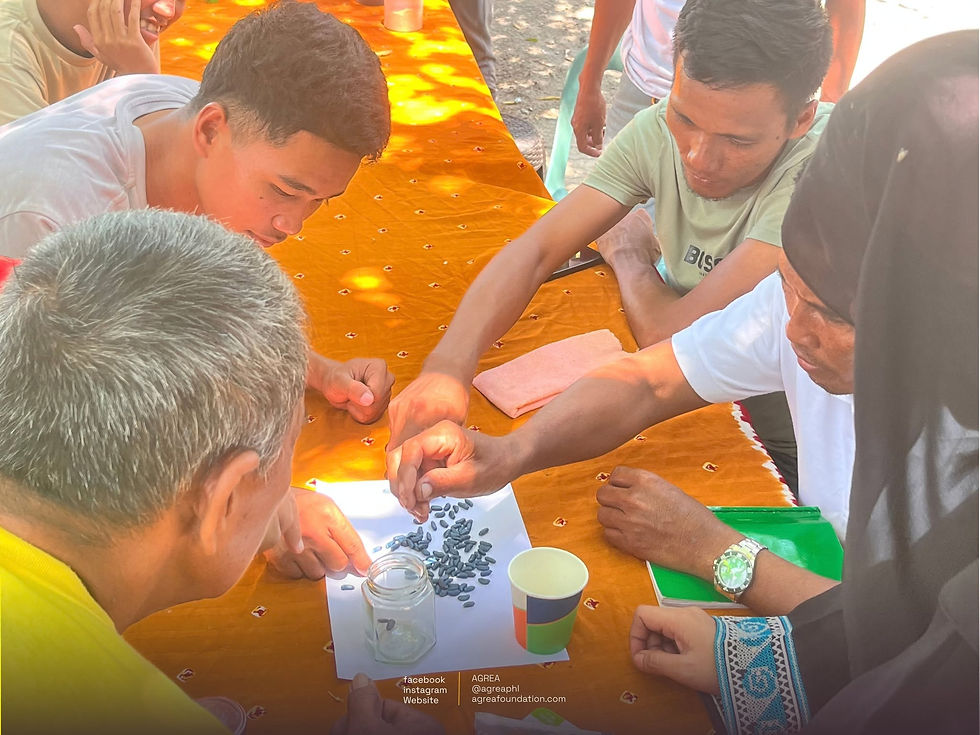
AGREA Foundation conducted a Regenerative Agriculture Learning Session with the SSB Ummahat and Muminats Agriculture Cooperative in the Bangsamoro Autonomous Region in Muslim Mindanao. Present were the cooperative's women members. Also present were their husbands, who farm in their own right and who joined the discussions and activities as farmers rather than as accompanying spouses. And present throughout were Ustads—Islamic religious leaders—who listened, asked questions, and learned alongside them.
That composition is not a detail to note in passing and then set aside. It changes what the session could accomplish.
A training attended only by women can teach women. A training attended by women, their husbands, and their religious leaders creates the possibility that what is learned is not compartmentalised as a women's activity—something that happens on the margins of household and community life—but taken up as a shared undertaking. Whether that possibility is realised depends on what happens afterward. But the room itself was arranged differently from the usual.
What the cooperative is
The organisation is documented in BARMM's own records under a longer name: the Gadungan SSB and Ummahat Mu'minats Agriculture Cooperative in Sultan sa Barongis, Maguindanao del Sur. In July 2025, the Ministry of Agriculture, Fisheries, and Agrarian Reform distributed 65 goats to five farmer cooperatives across Maguindanao del Sur, Maguindanao del Norte, and the Special Geographic Area. This cooperative was among the recipients, and it also received two rolls of netting to establish protective enclosures for its livestock.
That record matters for how the session should be read. This is not a newly formed group receiving its first exposure to agricultural support. It is an established cooperative that has already accessed government livelihood assistance and taken on the obligations that come with it—raising and breeding the animals, maintaining the enclosures, reporting on the grant.
Gadungan itself is a barangay of Sultan sa Barongis, a municipality in the marshlands of the Rio Grande de Mindanao basin, where the local economy rests on rice and corn. Farming in a marsh environment means working with water that arrives on its own schedule: too much in some seasons, too little in others. That context shapes what a session on soil, seed, and climate risk needs to address.
The word Ummahat carries its own history. In Bangsamoro communities it refers to a grassroots network of women and mothers within Moro Islamic Liberation Front communities; many members of women's organisations in the region belong both to Ummahat and to the Social Welfare Committee, the official women's wing of the MILF Central Committee. A cooperative bearing that name is not a generic farmers' group with women in it. It is an organisation rooted in a specific social and political history, whose members have spent years in social welfare work, grassroots organising, and the transition from conflict toward civilian institutions.
Why the presence of Ustads is significant
In Muslim communities in Mindanao, religious leaders are not peripheral figures. They shape norms, mediate disputes, and carry moral authority that government programmes cannot manufacture. The National Commission on Muslim Filipinos has made this explicit in its own climate work: the NCMF Climate Change Summit 2025, held under the theme "Leadership through Faith and Action for a Resilient Muslim Community," underscored the importance of Islamic scholars, ulamas, imams, ustadhs, asatidz, and aleemas in promoting climate change adaptation and mitigation.
NCMF Secretary Sheikh Sabuddin Abdurahim put the logic plainly: "This summit is not just about discussions; it is about aligning faith with action. Our goal is to empower Muslim communities to become frontliners in the fight against climate change".
That framing is directly relevant to an agricultural session. Decisions about what a household plants, whether it burns or composts crop residue, how it manages water, and whether it diversifies away from a single crop are not purely technical. They are shaped by what is considered proper, what is customary, and what respected figures in the community endorse. An Ustad who has sat through a session on soil health and seed saving is an Ustad who can speak about those practices from a position of familiarity rather than secondhand report.
The article does not claim that the Ustads endorsed any specific practice, issued guidance, or made commitments. AGREA's account describes them as asking questions, listening, and learning alongside the farmers. That is participation, and it is the precondition for anything further.
What the session covered
The session's five components followed the pattern established across this programme, delivered here to a mixed group of women, men, and religious leaders.
Seed banking and saving. Participants learned to identify good-quality seed and store it properly, with the aim of building their own supply of planting materials and reducing dependence on purchased seed.
The gendered dimension of this work is documented but frequently overlooked. Research on seed systems in the Philippines has found that women in farming communities "play an important role in the production, health, maintenance, and storage of seeds, but they are hardly recognized for their role". The Department of Agriculture's Agricultural Training Institute has promoted community seed banking as a means of conserving genetic resources at the community level and has specifically mobilised women's groups to establish them. A 2025 account of a Philippine women's cooperative describes the mechanism precisely: members keep a community seed house where labelled bottles hold rice, corn, legumes, and leafy greens; they borrow seed at planting time and return more after harvest, and they decide which varieties stay in circulation.
That last point is the one worth dwelling on. Seed banking is not only storage. It is a decision about which varieties continue to exist.
Seedling propagation using available materials. Participants explored raising seedlings in egg trays before transplanting. The method is simple: pierce the cells for drainage, fill with potting medium, sow, and when the seedlings are ready, cut the cardboard tray apart and plant each cell directly, because the cardboard breaks down in the soil without disturbing the roots.
The value is in the substitution. A nursery does not require purchased trays or a dedicated structure. It requires drainage, medium, water, light, and attention. For households where the person managing the seedlings is also managing children and cooking, a tray that fits on a sill or under a shade tree and can be tended in short intervals is a nursery that actually gets tended.
Nutrition. The session connected what participants grow with what their families eat: balanced and diverse diets, affordable and locally available nutritious foods, household food security, and proper nutrition during pregnancy, breastfeeding, and early childhood.
This is the practical content of nutrition-sensitive agriculture, which designs agricultural activity deliberately so that it improves nutrition outcomes—by diversifying what is grown and aligning production with household dietary needs. The need in BARMM is documented: a World Food Programme case study found that roughly 49 percent of individuals in the region experience chronic malnutrition. WFP has also conducted social and behaviour change research in Maguindanao specifically to understand the socio-cultural factors behind poor dietary practices among women and children, on the premise that dietary decisions are shaped by culture, cost, and custom rather than by knowledge alone.
Introduction to agriculture. Participants examined agriculture's role, agricultural technologies, climate risks, and adaptation through crop selection, land preparation, soil management, and farm planning.
The climate context is not hypothetical. On May 14, 2026, Chief Minister Abdulraof Macacua placed the entire BARMM under a state of calamity under Proclamation No. 0002, Series of 2026, citing the combined impact of the global oil crisis and El Niño. According to MAFAR Minister Abunawas Maslamama, around 800 rice and corn farmers in Maguindanao del Sur and Maguindanao del Norte had been affected; as of April 24, about 851 hectares of farmland across 36 municipalities and 167 barangays were damaged—537 hectares of rice and 314 hectares of corn—with losses of roughly 1,500 metric tons. The proclamation noted that climate models projected El Niño conditions to continue until early 2027.
Vegetable farming and regenerative practice. The final component covered crop diversification, soil health, biodiversity, planting schedules, and identifying quality vegetables for the market, alongside organic and regenerative agriculture: caring for soil, supporting biodiversity, reducing unnecessary chemical inputs, and making good use of local resources and knowledge.
In a marshland municipality dependent on rice and corn, the case for diversification is not ideological. A farm with one crop and one harvest window has one point of failure. A farm with several crops, staggered planting, and soil that holds moisture has several ways to absorb a bad season.

The partnership behind the session
The session is part of the continuing collaboration between AGREA Foundation and the World Food Programme, under a project funded by the Spanish Agency for International Development Cooperation.
WFP describes the project as a PHP 45 million (US$780,000) contribution from AECID to enhance agriculture-related livelihoods and boost the climate resilience of Indigenous women in BARMM, reaching 28,000 people from Indigenous and rural communities. Under the project, rural and Indigenous women undergo training in climate-resilient agriculture and leadership skills, women's cooperatives are strengthened by linking production to reliable markets, and activities incorporate social behaviour change to improve local food and nutrition practices.
WFP Philippines Representative and Country Director Regis Chapman framed the rationale in terms of frequency and intensity: "With the increasing frequency and intensity of climate emergencies in the Philippines, women are especially vulnerable. It is urgent that we strengthen their capacities and so that they can withstand shocks better".
The project's diagnosis rests on WFP's 2024 Leaving No One Behind study, which found that barriers such as climate-related risks hinder rural and Indigenous women from accessing resources and decision-making processes, resulting in lost livelihood opportunities and poverty. That finding is the reason a session on seed and soil is also, unavoidably, a session about who decides.
What the session does and does not establish
A learning session is an input. It is not evidence that participants have adopted seed banking, that they will raise seedlings in egg trays rather than buying them, that household diets will improve, or that farms will withstand the next dry spell.
Those outcomes depend on follow-through: whether stored seed germinates, whether the practices fit the labour and land available, whether the nutrition guidance is compatible with what households can afford, and whether the cooperative reinforces the practices in the months after the session.
The composition of this particular room creates a specific opportunity and a specific risk. The opportunity is that a practice discussed in the presence of husbands and religious leaders is more likely to be treated as a shared household and community matter rather than a woman's private project. The risk is that the presence of respected figures is mistaken for agreement, and that the session is reported as though consensus had been reached when what actually happened was that people listened.
The honest measure is not the size of the group or the warmth of the closing remarks. It is what appears in the following season: labelled jars of seed, trays of seedlings, a field with more than one crop in it, and a plate with more colour on it.
What comes next
For the participants, the next steps are small and concrete: select and store seed from the best plants at the next harvest; try one tray of seedlings; add one locally available vegetable to the household menu; test one soil-building practice on a small plot before applying it widely.
For the cooperative, the next step is to decide whether these practices become shared activities—a community seed bank, a collective nursery, a group purchase of storage containers—rather than individual habits.
For AGREA Foundation and WFP, the next step is to continue the collaboration and to track whether the sessions contribute to changes in practice. That tracking should be honest about what changes and what does not.
A note of appreciation
To the women of the cooperative who participated, to their husbands who came as farmers rather than as companions, and to the Ustads who spent the session listening and asking questions: agricultural knowledge travels through households and through the people a community trusts. The willingness to learn together is where that travel begins.
To learn more about AGREA Foundation's work with women farmers in BARMM and its partnership with the World Food Programme, explore our official channels. Organisations interested in supporting regenerative agriculture and nutrition programming can reach out through our contact page.


